This page is a plain definition. It isn't medical, legal, or financial advice.
Where did the term come from?
Writers and researchers started using "sandwich generation" in the late twentieth century to name a stage of life workplaces and policy mostly ignored. The metaphor stuck because it captures pressure from two directions. Nobody loves being compared to lunch.
The sandwich can be thicker than two layers: some adults help grandparents, parents, and children at once, sometimes called a club sandwich. The label is less important than what it describes: too little time, money stretched two ways, and people you love on both ends.
Who counts as sandwich generation?
You probably fit if most of these are true:
- You regularly help an aging parent or older relative with health, money, housing, appointments, or emotional support
- You are also raising kids, or still supporting adult children with rent, tuition, or the occasional rescue
- The care competes with your job, your marriage, or your sleep
- Mom's Medicare paperwork and a kid's soccer schedule land in the same week
You don't need a formal caregiver title. The sibling doing the midnight research and the one who flies in twice a year both feel the sandwich, though rarely equally. For dividing the work without a blowup, see sibling caregiving roles without a fight.
What pressures show up most often?
| Pressure | How it often feels |
|---|
| Time scarcity | Every calendar is full; yours is the overflow valve |
| Money stretch | Helping with parent costs and kid costs |
| Information overload | Medicare, scams, meds, school forms, all different dialects |
| Invisible labor | Coordination nobody notices until it stops |
| Guilt in both directions | "Not enough" for parents and for kids |
| Ambiguous authority | Wanting to help without taking over |
None of this means you're failing. It means the structure is hard.
How is sandwich caregiving different from "just helping Mom"?
Occasional help is an errand. Sandwich caregiving is a standing second job with no set hours: tracking prescriptions, decoding Explanation of Benefits letters, noticing that Dad's walk has slowed, fielding the sibling group chat, and still getting your own kids to school. The feeling shifts from "nice thing I do" to "if I drop this, something breaks."
That's why a few small systems (a shared checklist, an agreed way to hear how your parent is doing, clear roles) help more than one heroic weekend. Start with the aging parents care checklist and build it with your parent, not around them.
What helps without turning into a takeover?
- Say it out loud. Tell your partner or siblings you're in the sandwich, so the load is visible to someone besides you.
- Keep the conversations separate. Health sharing, money visibility, and Medicare help are three different asks; bundled together, they often get one no. See asking for health-sharing consent and talking about sharing finances.
- Help with Medicare without running it. Read how to help a parent with Medicare without taking over.
- Agree on a rhythm. A standing Sunday call, or a signal you both agreed to, feels better on both ends than a week of "just checking!" texts.
- Protect one thing that's yours. A run, a date night, a Saturday morning. Burnout helps no one.
Where FamSteady fits
A lot of the sandwich is guessing: is Mom sleeping, did that bill get paid. FamSteady lets your parent share the rhythms their iPhone already tracks (steps, sleep, heart rate) and connect a bank through a read-only link that can't move money, so the family hears "All is well" or "Worth a look." Your parent controls the sharing and can turn it off anytime. It won't fix the sandwich, but it takes some of the guessing out. Waitlist at famsteady.com.
What is the sandwich generation?
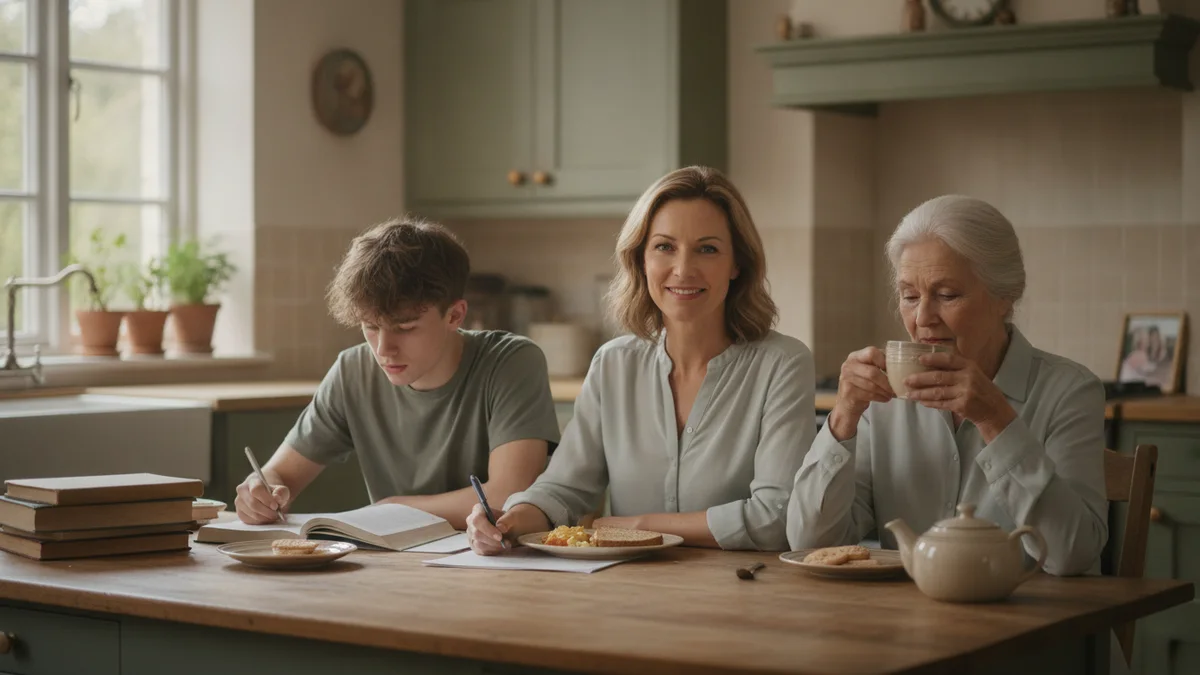
The sandwich generation is adults who care for aging parents or older relatives while also raising children or supporting adult kids. The "sandwich" is the middle position: obligations pulling in both directions, usually alongside a job. It describes a season of life rather than a diagnosis.
What ages are considered the sandwich generation?
There's no official age range. Most people who recognize the pattern are in their 40s and 50s. But a 30-year-old whose father had a stroke and a 65-year-old still paying an adult child's rent are both in it. What defines it is responsibility in both directions, whatever your age.
Is the sandwich generation only about money?
No. Money is a big part of it for many families: shared housing costs, medical bills, tuition. But time, advocacy, phone calls, and emotional weight count just as much. Plenty of sandwich-generation adults have enough money and no spare hour in the week, and that version is exhausting too.
How common is sandwich caregiving?
Millions of U.S. adults say they help aging relatives while also parenting or supporting adult children. The exact number depends on the survey and how it defines the terms. What's consistent is that it's common and mostly invisible. If your kitchen table feels crowded, you're not imagining it.
What's the difference between sandwich generation and caregiver?
"Caregiver" is the role: someone who regularly helps another person because of age, illness, or disability. "Sandwich generation" is doing that while also raising or supporting kids. You can be a caregiver with no children at home, and you can be sandwiched with a light load (mostly coordinating) or a heavy one (daily hands-on care).
How do I reduce sandwich generation stress?
Start by making the invisible visible. Write down who does what, share one checklist with your siblings, and ask your parent for an agreed way to know how they're doing instead of guessing from a phone call. Keep health, money, and benefits as separate conversations. Protect some time to recover. For medical, legal, and financial decisions, bring in a professional; this page can't stand in for one.
Can employers help sandwich-generation workers?
Some do, through caregiver benefits, flexible schedules, or an employee assistance program. Ask HR what already exists. FamSteady is exploring an employer benefit option; if it happens, employers would only ever see aggregate participation, never a parent's data, and it would still depend on the parent agreeing to share.