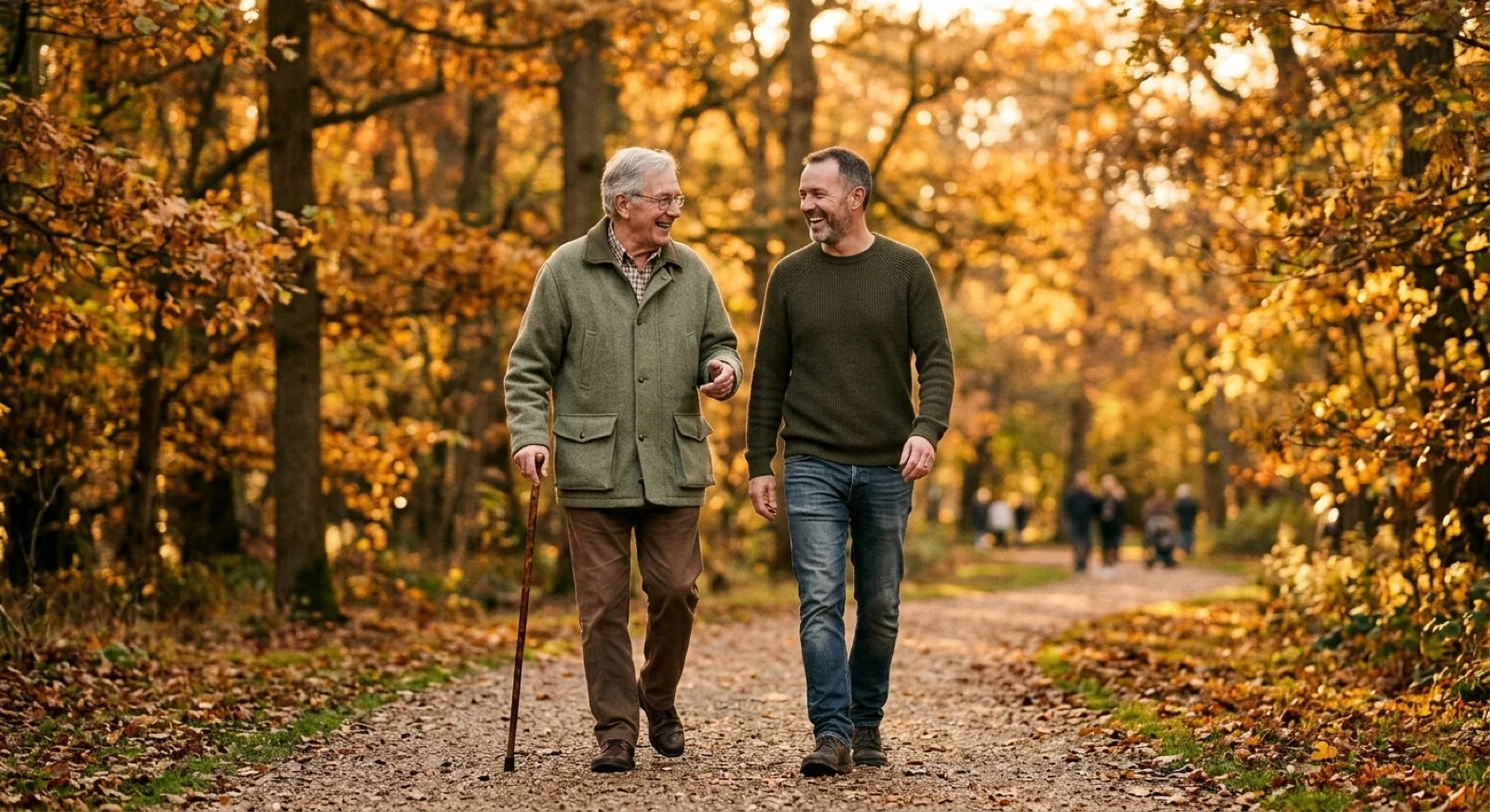
You noticed it before you had words for it. Maybe at the airport, when you found yourself slowing your stride so she could keep up. Maybe on the front path, watching him take the porch steps one at a time where he used to take them without thinking. Something in you registered a change — and then, being a kind person, you talked yourself out of it. He's just tired. It was hot. Everyone slows down.
Here's the honest middle ground: a slower walk is usually not an emergency, and it is almost never nothing. It's information — often about something fixable — and it deserves the same calm attention you'd give a change in appetite or sleep.
Why doctors treat walking as a vital sign
Geriatricians have taken to calling gait speed "the sixth vital sign," right alongside pulse and blood pressure, and the reason is beautifully simple: walking uses almost everything at once. Heart, lungs, muscles, bones, nerves, inner ear, vision, and the brain quietly planning every step. When any one of those systems starts to struggle, the walk is often where it shows first.
The research behind this is unusually strong. A landmark pooled analysis in JAMA followed more than 34,000 adults over 65 and found that how fast a person naturally walks tracks with survival to a startling degree — roughly a 12% difference for every 0.1 meters per second, a change too small to notice by eye. And a large 2022 analysis in The Lancet Public Health found that for adults over 60, the benefit of daily walking climbs until about 6,000 to 8,000 steps a day — the most active quarter of people had roughly half the mortality risk of the least active. The encouraging translation: nobody needs 10,000 steps. A real walk most days is most of the medicine.
A change is not a bad week
Everyone slows down with a cold, after a rough night, in January. What matters is never one afternoon — it's the pattern over weeks. Three questions cut through the noise:
- Is it a trend? Slower this month than last month, and slower last month than the month before — not just slower than the day you happened to notice.
- Is the world shrinking? Skipping the far grocery store, parking closer, quietly giving up the evening loop around the block. People often adjust their lives around a slowing walk before anyone names it.
- Is anything else changing with it? A slower walk plus new unsteadiness, or a slower walk plus more forgetfulness, means more than either alone.
What a slowing walk can mean — the fixable things first
This is the part worth reading twice, because the mind jumps to the scariest explanation and the odds usually point somewhere gentler. A walk can slow because of a painful hip or knee, an arthritis flare, foot problems or shoes that no longer fit right, inner-ear and balance issues, a medication side effect (dizziness is a common one, especially after a prescription change), changing vision, low mood, or plain deconditioning after an illness kept someone on the couch for a few weeks. Every item on that list is treatable, and several are trivially so. That's exactly why it's worth mentioning to a doctor rather than politely ignoring: the most likely explanations are the ones a doctor can actually do something about.
There is one combination that deserves a promptly booked appointment rather than a someday one. A 2020 analysis in JAMA Network Open, pooling six studies and nearly 9,000 older adults, found that people declining in both memory and walking speed had about six times the dementia risk of people aging typically — far higher than either change alone. That is not a diagnosis, and it's not destiny. It's a signal that says: don't wait for the annual physical. Say what you've seen, out loud, to a clinician.
The numbers a phone already knows
Here's something most families don't realize: if your parent carries an iPhone in a pocket, it has been quietly measuring their walk for years — walking speed, step length, walking asymmetry, and something called double support time, which is worth knowing about. It's the share of each stride when both feet are on the ground. As balance gets less certain, that number creeps up — the body buying stability by keeping two feet planted a little longer. Apple published the science behind these measurements in 2022, and they're a genuinely graceful window into mobility: no wearable, no test to perform, no behavior to change. The data your doctor would love to have already exists — it's just sitting unread.
Where FamSteady fits: this is precisely the rhythm FamSteady watches. Your parent's phone already sees the walk; FamSteady notices when the pattern genuinely shifts — over weeks, not one tired afternoon — and tells the family "this looks worth a look," in plain words, without a single graph your parent didn't agree to share. The research behind what we watch and why is laid out on
our evidence page.
How to bring it up — twice, gently
With your parent, don't lead with data, and don't lead with worry. Lead with company:
"Mom, I'm trying to walk more and I keep not doing it. Would you keep me company on Saturday mornings? I need the excuse — and honestly the conversation."
A standing walk together does three things at once: it's the single best thing for a slowing walk (movement), it lets you feel any change firsthand instead of guessing, and it is time together rather than surveillance. Nobody's dignity is on the table. If the moment ever comes to say more, you'll be saying it as a walking partner, not an inspector.
With the doctor, the rule is: bring data, not adjectives. "She seems slower lately" is easy to reassure away. "Her daily steps dropped from around six thousand to around three thousand over the past three months, and her walking speed is down too" is a finding — specific, dated, and something a good clinician will take seriously and act on. Numbers get appointments moving; vagueness gets "let's keep an eye on it."
And if watching the walk has you thinking about the other early signals — the finances are often where change shows up first — our guide to talking with a parent about money pairs naturally with this one.
Is a slower walk normal with aging?
Some slowing comes with age, with being less active, or with a temporary setback like a bad knee. Even so, a noticeable change from your parent's own usual pace, especially with unsteadiness or near-falls, is worth mentioning to a clinician. Normal and ignorable aren't the same thing. The population-level links to later problems are associations; they don't decide anything for one person.
How long should we watch a slowing walk before calling the doctor?
If it's held for a few weeks, or if it worries your parent, bring it to a routine visit sooner rather than later. Sudden neurological symptoms or a serious fall are different: those need urgent evaluation, not watchful waiting. When you can't tell which situation you're in, call the clinician's office and describe what you're seeing.
Can I measure walking speed at home?
Some families time a familiar hallway so they have something to compare against later. That's fine as a personal reference, but home tests are easy to misread, and doing it the same way each time counts for more than a precise figure. Don't treat a phone timer as a diagnosis. Share what you've observed with a clinician and let them measure properly.
What if my parent does not want to talk about it?
Let it go for now. Ask whether you can share one sentence at their next visit, and leave it there. In the meantime, help in ways that don't require a conversation: better lighting, cleared walkways, company on a longer errand. Bring it up again after a good day, not right after a scare.
Do step counts replace a doctor visit?
No. Step trends your parent has agreed to share can prompt a conversation at home, but they can't assess strength, nerves, heart, vision, or medications. If they're shared willingly, treat them as a hint that something has changed. They aren't medical care, and they aren't a diagnosis.
Should siblings all pile into the appointment?
One support person is usually enough, unless your parent wants more of you there. Before the visit, agree among yourselves on the two most important things you've observed, so the appointment stays focused. Too many voices in the room can drown out the patient, and a checkup turns into a debate nobody asked for.
Is mentioning gait the same as saying they need to move or give up driving?
No. Raising a change in how they walk is about safety and options, like physical therapy, pain treatment, or a few changes at home. It doesn't commit anyone to anything larger. Keep the first ask small: "Can we tell the doctor what we're noticing?" Driving and housing are separate conversations, and they deserve their own careful timing.